

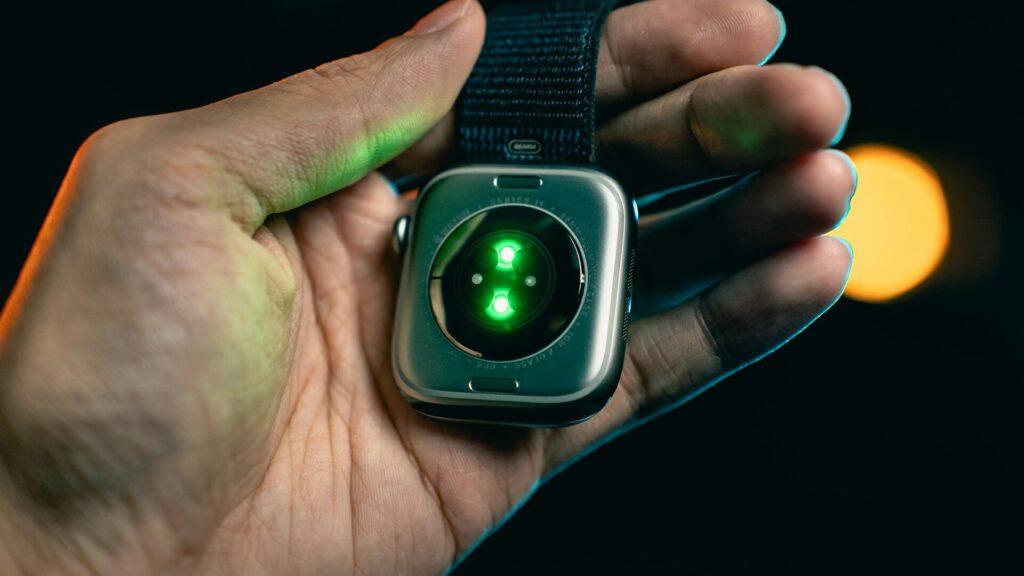
Flip almost any smartwatch or fitness tracker over and you will see flashing green lights. That is the optical heart rate sensor, and it measures your pulse dozens of times per second without a strap around your chest. Knowing how it works also explains why readings sometimes jump around.
How the Sensor Reads Your Pulse
The method is called photoplethysmography, or PPG. Here is the process in plain terms:
- Green LEDs shine light into the skin on your wrist.
- Blood absorbs green light, and more blood flows under the sensor with each heartbeat.
- Light detectors (photodiodes) measure how much light bounces back.
- The watch turns those tiny changes into a pulse wave and counts the beats.
- Algorithms filter out motion and calculate heart rate, and on many watches heart rate variability.
Many watches also use red and infrared light for blood oxygen readings, since those wavelengths react differently to oxygen-rich blood.
What Affects Accuracy
The table below shows common causes of off readings and what helps.
| Factor | Why It Matters | What Helps |
|---|---|---|
| Loose fit | Outside light leaks in | Snug, not tight, during workouts |
| Fast arm movement | Motion looks like a pulse | Chest strap for intervals and lifting |
| Cold skin | Less blood near the surface | Warm up before starting |
| Wrist tattoos | Ink absorbs light | Wear the watch on untattooed skin |
| Position on the wrist | Bone and tendons weaken the signal | One finger’s width above the wrist bone |
Optical Sensor vs Chest Strap
A chest strap reads the heart’s electrical signal directly, much like an ECG, so it reacts faster to sudden changes. Optical sensors are very good for resting heart rate, sleep and steady cardio, but can lag behind during sprints or weight training.
Quick answer: wrist sensors are accurate enough for daily tracking and steady runs, while a chest strap is better for interval training and precise zone work.
What Your Watch Does With Heart Rate Data
- Heart rate zones: guide workout intensity. Try our heart rate zone calculator.
- Calories: heart rate improves calorie estimates during exercise.
- Sleep stages: heart rate and movement help estimate light, deep and REM sleep.
- Fitness estimates: VO2 max uses heart rate with pace or power. See our VO2 max calculator.
- Alerts: many watches warn you about unusually high or low heart rate at rest.
How to Get Better Readings
- Wear the watch a finger’s width above your wrist bone.
- Tighten the band one notch for workouts, then loosen it afterward.
- Keep the sensor window clean. Our guide on how to clean your smartwatch shows how.
- Keep the watch software updated, since brands refine their algorithms.
Final Thoughts
An optical heart rate sensor reads your pulse by shining light into your skin and measuring how much bounces back. It is reliable for everyday tracking when the watch fits well, and a chest strap fills the gap for fast-changing workouts.
Explore more sensor guides in our features explained section.
FAQs
Why does my watch use green light?
Blood absorbs green light strongly. That makes the change in blood volume with each heartbeat easier to detect.
Is wrist heart rate accurate?
Yes, for resting heart rate and steady exercise. Accuracy drops during sprints, lifting and other fast arm movement.
Can tattoos affect heart rate readings?
Yes, dark ink can block the light. Wearing the watch on untattooed skin usually helps.
Should I buy a chest strap?
Only if you train with intervals or exact zones. For daily tracking, the wrist sensor is enough.



Write Your Review
No reviews yet. Be the first to share your experience!