

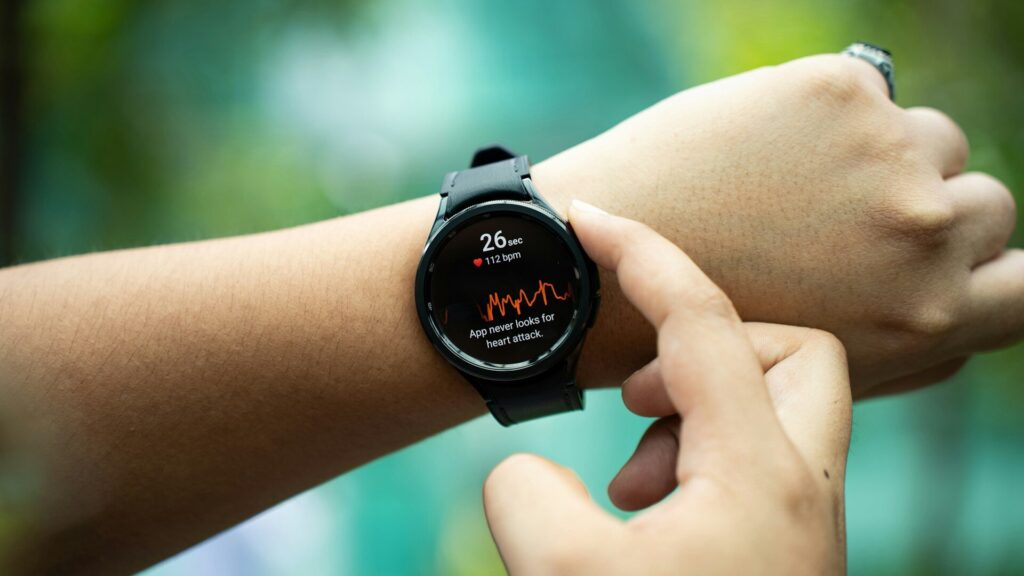
Many smartwatches can now record an electrocardiogram in about 30 seconds. An ECG on a smartwatch is a genuinely useful health tool, but it is easy to expect too much from it. Knowing what it can and cannot detect helps you use it wisely.
How a Smartwatch ECG Works
A hospital ECG uses 12 leads placed around the chest. A smartwatch records a single-lead ECG instead.
- An electrode sits on the back of the watch, against your wrist.
- A second electrode is in the crown, button or bezel.
- When you touch it with a finger from the other hand, you complete a circuit across your chest.
- The watch records your heart’s electrical signal for about 30 seconds and classifies the rhythm.
What It Can and Cannot Detect
The table below summarizes the limits of a single-lead reading.
| Can Help Detect | Cannot Detect |
|---|---|
| Signs of atrial fibrillation (AFib) | Heart attacks |
| Normal sinus rhythm | Blood clots or stroke |
| Unusually high or low heart rate during the reading | Heart failure |
| Readings that need a doctor’s review | Blocked arteries or high cholesterol |
Quick answer: a smartwatch ECG is designed to spot signs of AFib, not heart attacks or other heart disease.
Understanding Your Result
- Sinus rhythm: the heart is beating in a regular pattern during the reading.
- Atrial fibrillation: an irregular pattern that suggests AFib. Share it with a doctor.
- Inconclusive: the watch could not classify the reading, often due to movement or a loose fit.
- High or low heart rate: the rate was outside the range the app can classify.
Most apps let you export a PDF of the reading to share with your doctor.
Which Watches Offer ECG
ECG apps are available on current Apple Watch Series and Ultra models, many Samsung Galaxy Watch models through Samsung Health Monitor, Google Pixel Watch, select Fitbit and Garmin models, and others. Availability depends on your country, and some brands require a phone from the same maker. Most ECG apps are intended for adults 22 and older.
For setup on Galaxy, see our Samsung Health guide. On iPhone, results appear in Apple Health.
How to Take a Clean Reading
- Sit down and rest your arm on a table.
- Make sure the watch is snug and the back is clean.
- Touch the crown or button lightly, without pressing hard.
- Stay still and quiet for the full 30 seconds.
Our guide on how optical heart rate sensors work explains how ECG differs from everyday heart rate tracking.
Final Thoughts
An ECG on a smartwatch is a convenient way to check for signs of AFib and to capture a rhythm to show your doctor. It cannot rule out a heart attack or other heart conditions, so chest pain, shortness of breath or fainting always need emergency care, whatever the watch says.
Find more sensor guides in our features explained section.
FAQs
Can a smartwatch detect a heart attack?
No, a smartwatch ECG cannot detect a heart attack. Call emergency services if you have symptoms.
Is a smartwatch ECG accurate?
It is accurate for its intended purpose, spotting signs of AFib. It does not replace a 12-lead ECG at a clinic.
How often should I take an ECG on my watch?
Whenever you feel symptoms such as a racing or skipping heartbeat. Follow your doctor’s advice if you have a heart condition.
Why does my ECG say inconclusive?
Movement, a loose fit or a weak signal are common causes. Sit still, rest your arm and try again.


Write Your Review
No reviews yet. Be the first to share your experience!